How to Check Your Mass Airflow (MAF) Sensor
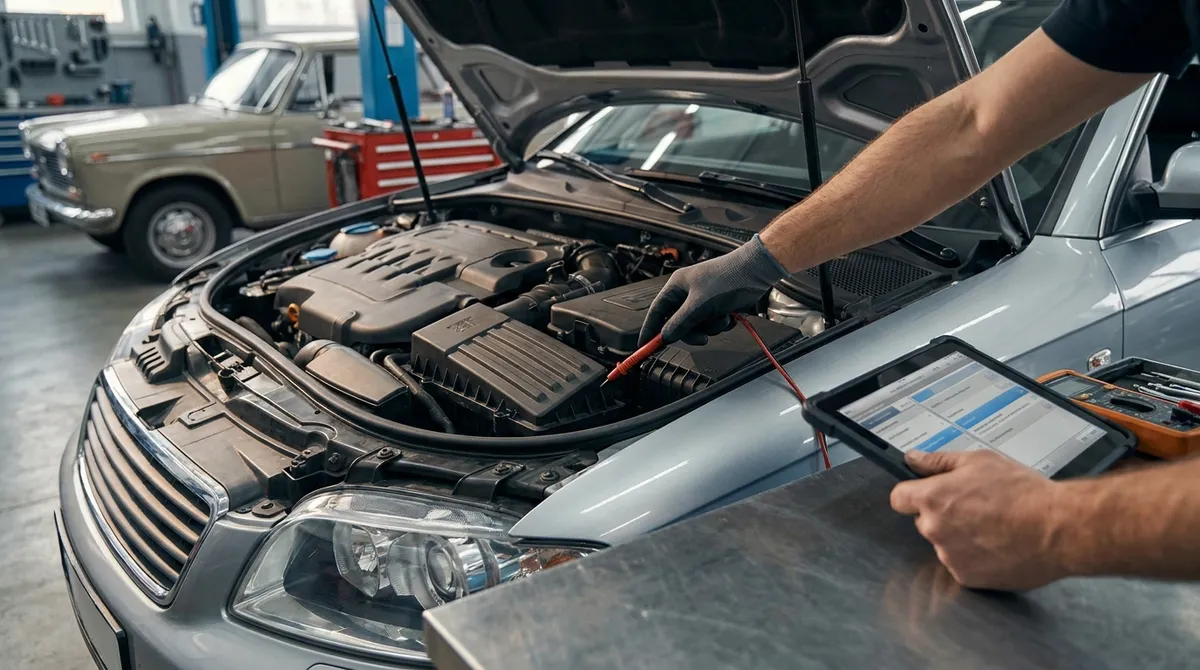
The Mass Airflow (MAF) sensor is a small but critical part of your engine’s brain. It measures how much air is coming into the engine, which helps the computer figure out how much fuel to inject. If this sensor isn’t reading right, your engine can stumble, waste gas, or just generally act up.
What Does a MAF Sensor Do?
Think of the MAF sensor as your engine’s nose. It sits in the air intake duct between the air filter box and the throttle body. Inside is a heated wire or thin heated film: the more air flows past it, the more it cools, and the sensor turns that cooling into a signal that tells the engine control unit (ECU) the mass of air entering the engine. The ECU uses this, along with data from other sensors, to calculate how much fuel to inject. If the MAF sensor gives bad data, the ECU can’t mix the fuel and air properly, leading to a range of performance issues.
Signs Your MAF Sensor Might Be Acting Up
A bad MAF sensor can cause a variety of problems, often mimicking other engine issues. If you’re noticing any of these, it’s worth checking your MAF:
- Rough idle or stalling: The engine might struggle to hold a steady idle, especially when you’re stopped, and it may even die. See why your car stalls at idle or stops for the other common causes.
- Poor acceleration or hesitation: When you step on the gas, the car might feel sluggish or hesitate before picking up speed. Our guide to why your car feels sluggish and loses power covers the wider list of suspects.
- Reduced fuel economy: A skewed reading throws off the air-fuel mixture, and an engine running rich burns more fuel than it needs to.
- Check Engine Light (CEL): MAF circuit and performance faults usually set codes P0100 through P0104, most often P0101 (see our P0101 guide). A MAF that misreads can also show up as a lean or rich code such as P0171 or P0172.
- Hard starting or stalling just after start: Some engines crank longer than normal or stumble and die right after they fire up.
These symptoms can point to many different problems, so it’s always good to start with a systematic check. You can find more general information on diagnosing common car problems in our symptoms guide.
First Check: The Visual Inspection
Before you grab any tools, give the MAF sensor and its surroundings a good look with the engine off.
- Locate the MAF sensor: It’s usually a small module plugged into the air intake tube between the air filter box and the throttle body.
- Inspect the sensor itself:
- Wiring: Check the electrical connector and wiring harness for any signs of damage, fraying, or corrosion. Make sure the connector is seated firmly and locked.
- Sensor element: Unplug the connector and remove the sensor (usually two screws or a clamp) to look at the fine wire or film inside. Look for dirt, oil film, or debris. Don’t touch the element or blow compressed air on it; it’s very delicate.
- Check the air intake system:
- Air filter and air box: A clogged filter restricts airflow, and a filter or air box lid that doesn’t seal lets unfiltered dirt reach the sensor element. Make sure the filter is clean and the lid is clipped down.
- Intake tube: Look for cracks, tears, or loose clamps in the intake tube after the MAF sensor. Air that enters there never passes the sensor, so the engine gets more air than the MAF reports. Our guide to diagnosing vacuum leaks with basic tools shows how to track these down.
Testing with a Scan Tool (The Smart Way)
The most effective way to check a MAF sensor’s readings is with an OBD-II scan tool that can display live data. This lets you see what the sensor is actually telling the ECU in real time.
- Set up safely: Park on level ground with the parking brake set and the transmission in park or neutral. Run the engine outdoors or with the garage door fully open, never in a closed garage.
- Connect the scan tool: Plug it into the diagnostic port, usually under the dash on the driver’s side.
- Warm up the engine: Let it reach normal operating temperature, then switch off the A/C, headlights, and rear defroster so they don’t add load.
- Find the MAF reading: In the “live data” or “data stream” menu, look for “MAF” or “Mass Air Flow Rate,” usually shown in grams per second (g/s). Some tools can also show the sensor’s voltage or frequency.
- Check warm idle: A common rule of thumb is about 1 g/s per liter of engine displacement at warm idle. A warm 2.0 L four-cylinder idling near 2 g/s is in the normal range, and a 5.0 L V8 near 5 g/s. Many engines read a little higher, and accessories or a cold engine push the number up. These are rough ballparks, not specifications.
- Raise the rpm in park or neutral: Slowly bring the engine up to about 2,500–3,000 rpm and let it come back down. The reading should rise and fall smoothly with engine speed, without dropouts or spikes. With no load on the engine, it won’t get anywhere near full-throttle numbers. You’re only checking that the signal tracks smoothly.
- Check under load on a road test: The full-load check happens on the road. Have a passenger watch the readings, or set your scan tool to record them. Never look at the screen yourself while driving. On a safe, empty stretch of road and within the speed limit, accelerate firmly at full throttle in a lower gear. A healthy naturally aspirated 2.0 L engine typically peaks somewhere around 80–120 g/s at wide-open throttle near its redline, and turbocharged engines read higher. If the reading barely climbs, the sensor may be under-reporting.
That full-throttle ballpark comes from simple math. A four-stroke engine draws in its displacement once every two revolutions, so a 2.0 L engine at 6,000 rpm can pull in at most about 100 liters of air per second. At sea level that’s roughly 120 g/s, and real engines fill their cylinders less than completely, so actual peaks land a bit lower.
About voltage: If your sensor sends an analog voltage signal and you back-probe its signal wire with a multimeter (use the wiring diagram for your vehicle), the voltage typically starts low at idle, often somewhere around 0.5–1.5 V, and climbs smoothly with airflow to roughly 4–4.5 V at full load on many designs. Some sensors send a frequency or digital signal instead, so check the spec for your sensor before judging the numbers.
Your vehicle’s service information is the final word on what’s normal. You can also ask the AI Mechanic about your specific vehicle.
If your MAF readings are consistently low, high, or erratic compared with what’s expected, the sensor may not be working right. Rule out intake and vacuum leaks too, since air that sneaks in after the sensor makes the MAF reading look low.
Cleaning or Replacing?
If your MAF sensor is dirty, sometimes a good cleaning can bring it back to life.
- Cleaning: Use only a dedicated MAF sensor cleaner. These cleaners are designed to be safe for the delicate sensor elements and evaporate without leaving residue. Never use carb cleaner, brake cleaner, or compressed air, as they can damage the sensor. With the engine off, unplug the connector, remove the sensor, spray the element without touching it, and let it dry completely before reinstalling and reconnecting it.
- Replacing: If cleaning doesn’t fix the problem, or if the sensor is physically damaged, replacement is usually the next step. MAF sensors are often plug-and-play, but make sure you get the correct part for your vehicle. A quality replacement is worth it, because cheap sensors can read inaccurately. After replacement, clear any stored trouble codes with your scan tool and take a test drive to confirm the light stays off.
Testing your MAF sensor can save you from replacing parts you don’t need. If you’ve gone through these steps and are still scratching your head, it might be time to take it to a trusted shop for a deeper look.