O2 Sensor Replacement: One or All?
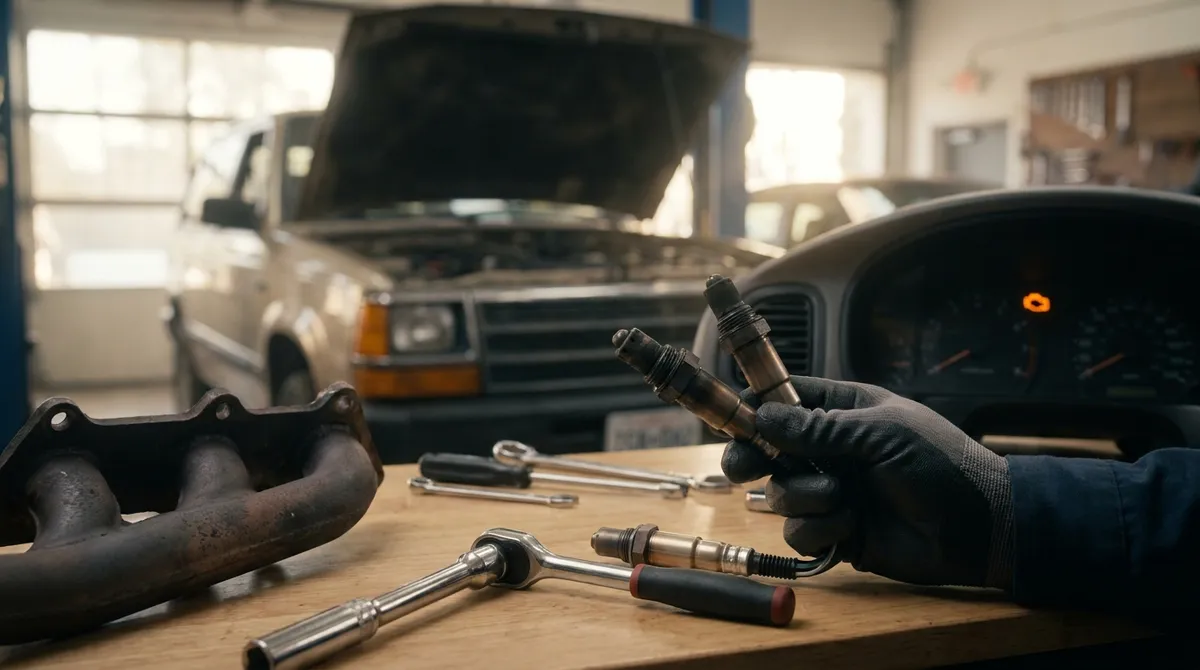
Your check engine light just popped on, and the code points to an oxygen sensor. Now you’re staring at the parts counter, wondering if you should just buy the one the computer flagged, or if it’s smarter to replace all of them while you’re at it. It’s a common question, and the answer isn’t always a simple yes or no.
What an O2 Sensor Does and Why It Matters
Oxygen sensors are critical for your engine’s health and efficiency. They’re basically tiny sniffers in your exhaust system, measuring the amount of unburned oxygen leaving the engine. This information goes straight to your car’s computer (the ECU), which then adjusts the fuel-air mixture to keep things running just right.
When an O2 sensor goes bad, it can mess with that delicate balance. You might notice worse gas mileage, a rough idle, or even a rotten egg smell from the exhaust. Most commonly, though, you’ll just see that check engine light staring back at you. If you’re curious about why your check engine light is on, we’ve got a whole guide on that. Common codes related to O2 sensors include P0133 (slow response), P0135 (heater circuit malfunction), or even P0420, which can sometimes be a sensor issue instead of a bad catalytic converter.
When to Replace Just One O2 Sensor
If your car’s computer throws a specific code for one oxygen sensor, and that’s the only code you’re getting, often replacing just that one sensor is the right call. This is especially true if:
- Your car is relatively new or has low mileage. Sensors don’t typically fail in a synchronized way on newer vehicles unless there’s an underlying issue.
- The code points to a specific circuit failure. For example, a P0135 code (O2 Sensor Heater Circuit Malfunction - Bank 1 Sensor 1) means the heater element in that specific sensor isn’t working. Replacing just that sensor will fix the problem.
- You find physical damage. Sometimes, a wire gets chewed by a rodent or the sensor itself gets damaged by road debris. In these cases, the failure is isolated.
If you’re dealing with a single, clear-cut O2 sensor code and your vehicle isn’t ancient, starting with just the one is usually the most practical and cost-effective approach.
When to Consider Replacing More Than One
There are definitely situations where replacing more than one O2 sensor makes sense, or even all of them.
- High Mileage: Oxygen sensors wear out over time. If your car has over 100,000 to 150,000 miles on the original sensors, and one has failed, it’s a good bet the others aren’t far behind. Their lifespan is finite, and they degrade slowly, becoming less accurate before they completely fail.
- Multiple O2 Sensor Codes: If you’re getting codes for several sensors at once, or codes for sensors on different banks (e.g., Bank 1 Sensor 1 and Bank 2 Sensor 1), it’s a strong indicator that they’re all aging out.
- Preventative Maintenance: If you’re already under the car replacing one hard-to-reach sensor, and the others are easily accessible and original, it might save you time and labor down the road to replace them all at once. Think of it like replacing all your spark plugs at the same time, even if only one is misfiring.
- Fuel Economy Concerns: Old, sluggish O2 sensors, even if not completely failed, can cause your engine to run rich or lean, hurting your gas mileage. If you’re chasing better fuel economy on an older car, replacing all original O2 sensors can sometimes help.
- Getting Specific Advice: If you’re unsure, or have multiple codes, using a tool like the MECH AI Mechanic can help you sort through the symptoms and codes specific to your vehicle and give you a clearer path forward.
Upstream vs. Downstream: Does it Matter?
Yes, it does. Most cars have at least two O2 sensors:
- Upstream (Pre-Cat) Sensors: These are located before the catalytic converter. They’re the primary sensors that tell the ECU how much oxygen is in the exhaust before it hits the catalytic converter. This data is crucial for adjusting the fuel-air mixture for optimal combustion and emissions. If you’re getting a P0171 lean code, a faulty upstream O2 sensor could be a contributor.
- Downstream (Post-Cat) Sensors: These are located after the catalytic converter. Their main job is to monitor the catalytic converter’s efficiency. They compare the oxygen levels after the cat to the levels before it. If the cat isn’t doing its job, you’ll often get a P0420 or P0430 code.
If an upstream sensor fails, it has a direct and immediate impact on engine performance and fuel economy. If a downstream sensor fails, it primarily affects emissions monitoring and can trigger a check engine light, but usually won’t cause driveability issues.
Because upstream sensors work harder and are more critical for engine operation, they tend to wear out faster. If you’re replacing an upstream sensor on a V6 or V8 engine (which will have two upstream sensors, one for each “bank” of cylinders), it’s often a good idea to replace both upstream sensors at the same time for balanced performance, especially on high-mileage vehicles. Downstream sensors can often be replaced individually as needed.
The Bottom Line
There’s no single rule for O2 sensor replacement. Start by diagnosing the specific code your car is throwing. If it’s a single, clear fault on a lower-mileage vehicle, replacing just that one sensor is usually fine. If your car has high mileage, you’re seeing multiple codes, or you’re already doing a repair where other sensors are easy to access, replacing more or all of them can be a smart move for long-term reliability and performance. When in doubt, consult your vehicle’s specific repair information or get advice from a trusted mechanic. For more diagnostic help, check out the MECH AI fix database.