Why Is My Check Engine Light On? Solid vs. Flashing
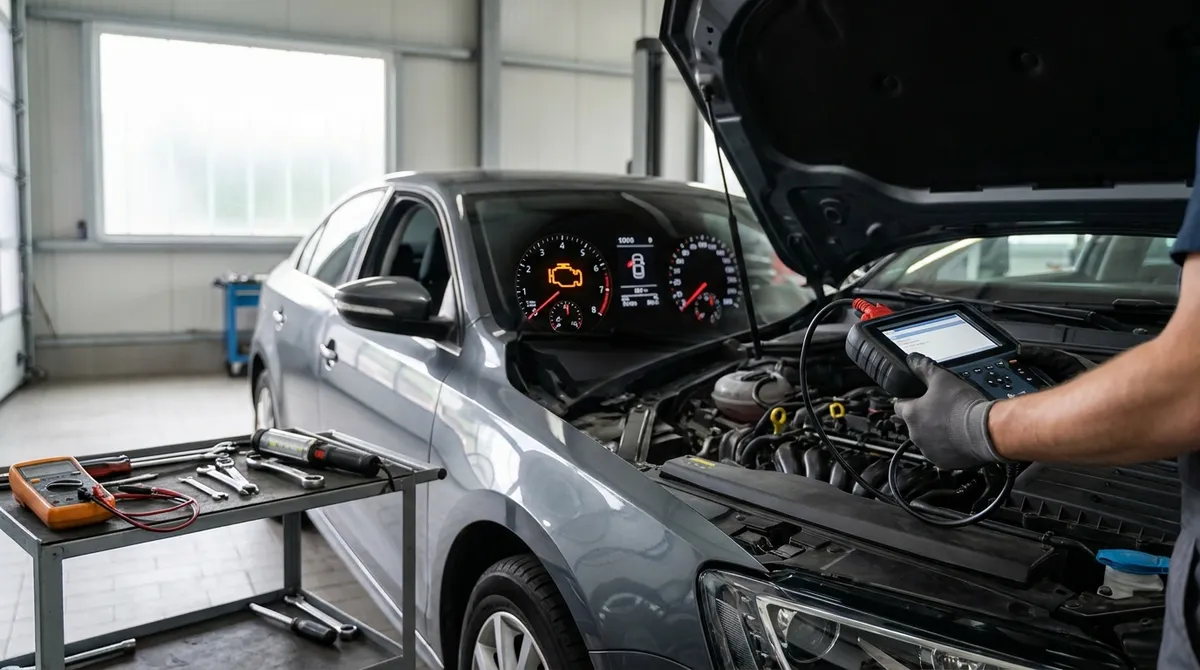
A check engine light means your car’s computer has stored a diagnostic trouble code (DTC). A solid light means a non-critical fault you should diagnose soon. A flashing light means an active engine misfire that can destroy your catalytic converter within minutes — stop driving and get it towed.
Is it safe to drive with the check engine light on?
Solid light: Usually yes, for short trips. The car has detected a fault but isn’t in immediate danger. Diagnose it within a few days.
Flashing light: No. A flashing light means raw fuel is reaching the catalytic converter. Pull over, and tow rather than drive. A replacement cat runs $600–$2,400.
Solid vs. flashing: what the difference actually means
The light is the same bulb; the behavior is the message:
- Steady/solid — an emissions, sensor, or fuel-trim fault. The car will run, often normally. Common examples: a degraded catalytic converter, a lean fuel mixture, or an EVAP leak.
- Flashing/blinking — a severe, active misfire happening right now. Unburned fuel is dumping into the exhaust. Continued driving risks expensive catalyst damage.
The most common causes, by how often they happen
- Loose or failing gas cap / EVAP leak — the cheapest and one of the most common triggers. See P0455 (large EVAP leak).
- Degraded catalytic converter — frequently misdiagnosed. Learn how to tell the cat from the O2 sensor on the P0420 page.
- Lean fuel mixture (vacuum leak or MAF) — rough idle and poor economy. See P0171 (system too lean).
- Engine misfire — the flashing-light cause. See P0300 (random/multiple misfire).
How to find your exact code
The light alone doesn’t tell you the code. You need an OBD2 scanner (or the MECH AI app with a Bluetooth dongle) to read the stored DTC, then look up what it means for your specific vehicle.
Not sure what your code means for your car? Ask the AI Mechanic free → — describe your symptom or enter the code and get the likely causes ranked for your exact year, make, and model.
Related trouble codes
- P0420 — Catalyst System Efficiency Below Threshold
- P0300 — Random/Multiple Cylinder Misfire
- P0171 — System Too Lean (Bank 1)
- P0455 — Large EVAP Leak
Browse the full OBD2 code library or the AI repair database for any code on any vehicle.
Frequently asked
What are the most common reasons a check-engine light comes on?
A loose or bad gas cap, a failing oxygen sensor, worn spark plugs or coils causing misfires, a catalytic-converter or EVAP issue, or a MAF sensor problem are among the most common. A scan tool or app reads the stored code that tells you which.
Is it safe to drive with the check-engine light on?
A steady light usually means it is safe to drive to get it checked soon. A flashing light means an active misfire that can damage the catalytic converter — reduce speed and get it looked at right away.
Can I clear a check-engine light myself?
You can clear the code, but if the underlying problem is not fixed it will come back — and clearing it also erases readiness monitors needed to pass emissions. Diagnose the cause first; the free AI Mechanic can interpret the code for your vehicle.