P0420 Code: Is It the Cat or Just a Sensor?
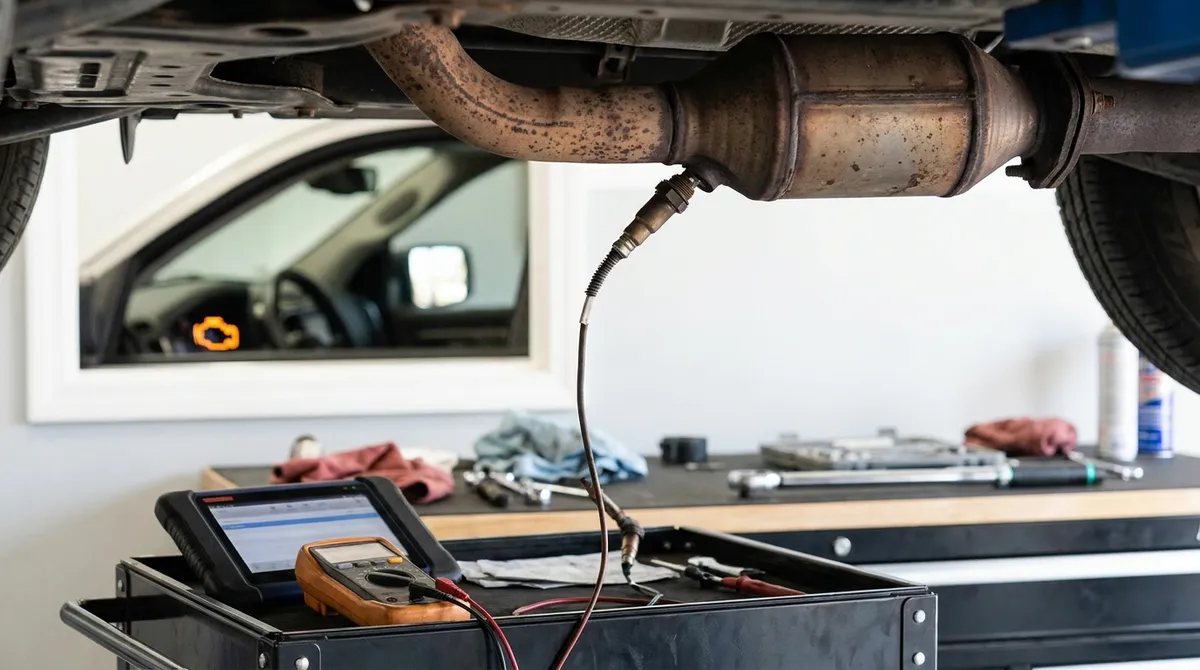
The P0420 code, “Catalyst System Efficiency Below Threshold (Bank 1),” is one of those codes that can make a mechanic’s wallet clench up. It means the vehicle’s catalyst monitor measured performance below its calibrated threshold. It does not prove that the catalytic converter failed, and it does not prove that the downstream oxygen sensor failed. Before pricing parts, diagnose the system.
What P0420 Really Means
Your catalytic converter is a crucial part of the exhaust system, turning harmful pollutants into less harmful ones. To make sure it’s working, your vehicle’s computer (ECU) uses two oxygen (O2) sensors for each bank of cylinders: an upstream sensor before the cat and a downstream sensor after it.
- The upstream O2 sensor measures oxygen content in the exhaust before it hits the cat. This reading helps the ECU adjust the air/fuel mix. It should fluctuate quite a bit.
- The downstream O2 sensor measures oxygen content after the cat. If the cat is working right, it should store oxygen, causing the downstream sensor’s reading to be relatively stable and lower than the upstream.
Many vehicles compare upstream and downstream oxygen-sensor behavior as part of the catalyst monitor. The exact algorithm, enabling conditions, thresholds, and sensor types vary by vehicle. A P0420 result tells you that the monitor failed; manufacturer service information tells you how that result should be tested on the exact model.
Common Causes That Aren’t the Cat
Before you condemn the catalytic converter, it’s smart to check a few other things that can throw a P0420 code. These are often cheaper and easier to fix.
- Exhaust Leaks: A leak in the exhaust system before or between the O2 sensors can let in outside air, messing with the sensor readings and making the cat look bad. Check for soot marks or listen for a hiss.
- Fouled Spark Plugs or Misfires: If your engine isn’t burning fuel completely, unburnt fuel can get into the exhaust and damage the catalytic converter over time. It can also confuse the O2 sensors.
- Fuel System Issues: Running too rich (too much fuel) or too lean (not enough fuel) can cause problems. A failing fuel injector, a bad fuel pressure regulator, or even a dirty air filter can contribute.
- Engine Coolant Temperature Sensor: If this sensor is giving bad readings, the engine might run rich, which can harm the cat.
- Mass Airflow (MAF) Sensor: An inaccurate MAF sensor can cause the ECU to miscalculate the air/fuel ratio, leading to rich or lean conditions that affect cat efficiency and O2 sensor readings.
- O2 Sensor Problems: A biased, slow, contaminated, damaged, or poorly connected sensor can make catalyst-monitor data unreliable. Sensor and heater faults often set additional sensor-specific codes, which should be diagnosed first.
- Slow Response: An aging O2 sensor might still technically work but responds too slowly, confusing the ECU.
- Contamination: Sensors can get fouled by oil, coolant, or fuel additives, leading to inaccurate readings.
- Heater Circuit Failure: If the O2 sensor’s heater circuit fails (which often throws a separate code like P0135 or P0141), the sensor won’t reach operating temperature quickly, leading to bad data.
How to Test the O2 Sensors
This is where a good scan tool comes in handy. You’ll want to look at live data.
- Visual Inspection: Check the wiring and connectors for both upstream and downstream O2 sensors. Look for any signs of damage, fraying, or corrosion. Make sure they’re plugged in tight.
- Live Data Check (Warm Engine):
- Identify the sensor type before interpreting voltage. Conventional narrowband zirconia sensors, wideband air/fuel sensors, and some manufacturer strategies report differently.
- Compare upstream and downstream behavior under the enabling conditions specified for the vehicle. On a conventional system, a downstream signal that closely tracks the upstream signal can support a catalyst-efficiency diagnosis—but it is not enough by itself.
- A signal that is fixed, implausible, slow, or accompanied by a sensor/heater code needs a sensor-circuit diagnosis before the catalyst result can be trusted.
- If the scan tool exposes Mode $06 catalyst-monitor results, compare them with the manufacturer thresholds and test procedure for the exact vehicle.
- Fuel Trims and Misfire Data: Check short- and long-term fuel trims, misfire counters, and related codes. Large corrections or active misfires can damage a converter or invalidate a catalyst test. Acceptable values depend on the vehicle and operating condition, so use manufacturer specifications instead of one universal cutoff.
When It’s Probably the Catalytic Converter
After you’ve ruled out exhaust leaks, misfires, fuel system issues, and confirmed your O2 sensors are responding correctly, then it’s time to consider the catalytic converter itself.
Signs that point to a failing cat:
- Reduced Engine Performance: The vehicle feels sluggish, especially when accelerating or going uphill. A clogged cat restricts exhaust flow.
- Poor Fuel Economy: The engine has to work harder to push exhaust through a restricted cat.
- Sulfur Smell: A “rotten egg” odor can accompany a fuel-control or catalyst problem, but it is not a stand-alone converter test.
- Rattling Sounds: If the internal honeycomb structure of the cat breaks apart, you might hear a rattling noise from under the vehicle, especially when starting or shutting off the engine.
- Overheating: In severe cases, a clogged cat can cause excessive heat, sometimes even glowing red. This is a fire hazard and needs immediate attention.
If the engine is running correctly, there are no relevant leaks or sensor faults, and the catalyst monitor still fails the vehicle-specific procedure, the converter becomes the leading suspect. Some manufacturer procedures use Mode $06 oxygen-storage values, controlled drive cycles, temperature checks, or other tests before authorizing replacement.
Next Steps
Diagnosing a P0420 code requires a systematic approach. Don’t just throw parts at it. Start with the simplest, cheapest checks first. A good scan tool is your best friend here. You can use tools like the MECH AI app to help interpret live data and guide your diagnostic process. If you’ve gone through these steps and are still scratching your head, or if you’re dealing with advanced symptoms like severe performance loss or rattling, it’s time to take it to a trusted shop. They have specialized tools and experience to confirm a catalytic converter failure.
Sources
Frequently asked
Does P0420 always mean I need a new catalytic converter?
No. P0420 means the catalyst monitor measured efficiency below its calibrated threshold; it does not identify the failed part. Check for other codes, exhaust leaks, misfires, fuel-control problems, sensor faults, and vehicle-specific test results before replacing either a sensor or the converter.
Is it safe to drive with a P0420 code?
Usually yes, short-term — the car runs and it will not strand you. But it will fail an emissions test, and if the converter really is failing it can eventually clog and cut power, so diagnose it rather than ignore it.
How do I tell if it is the cat or the O2 sensor?
Start with sensor-specific codes, wiring, exhaust leaks, fuel trims, misfires, and manufacturer test information. Comparing upstream and downstream sensor behavior can support the diagnosis, but waveform shape alone is not conclusive and varies by sensor type and vehicle strategy.