Exhaust Manifold Leak: Ticking Noise & Power Loss
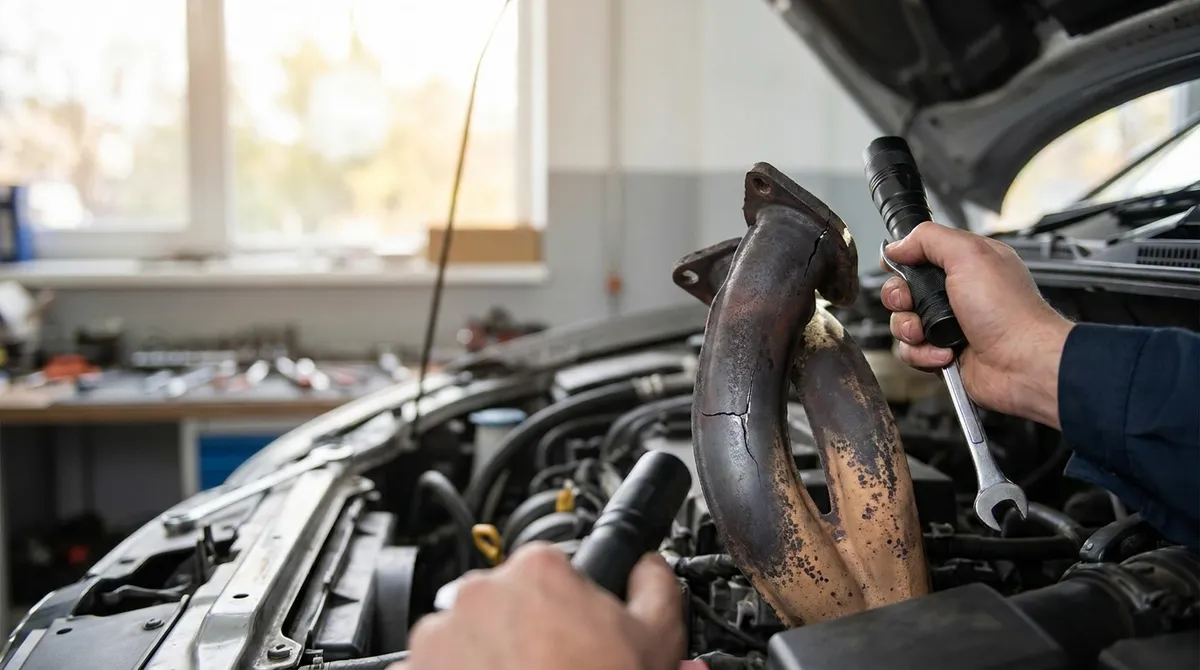
Hear a ticking noise when you start your car, especially when the engine is cold? Or maybe your engine just doesn’t feel as strong as it used to, like it’s lost a step? These could be signs of an exhaust manifold leak. It’s a common problem that’s worth checking out before it turns into something bigger.
What an Exhaust Manifold Does
Think of your exhaust manifold as the first stop for all the burned gases leaving your engine’s cylinders. Each cylinder has an exhaust port, and the manifold is a heavy metal casting or fabricated pipe assembly that bolts to the engine head. Its job is to collect these hot, spent gases from all cylinders and funnel them into a single pipe that leads to the rest of the exhaust system, including the catalytic converter and muffler. It’s a critical part of getting those gases out efficiently.
The Telltale Ticking Noise
The most common symptom of an exhaust manifold leak is a ticking or tapping noise coming from the engine bay. It often sounds like a sewing machine or a small, persistent click. This noise is usually loudest when the engine is cold and first started. As the engine warms up, the metal of the manifold and cylinder head expands, which can temporarily seal the small crack or gap causing the leak, making the noise quiet down or disappear.
Why does it tick? Exhaust gases are under pressure, and when there’s a crack in the manifold, a loose or broken stud, or a failed gasket, these gases escape with a sharp, rapid puffing sound. Since the engine is constantly pushing out exhaust, it creates that rhythmic ticking. If you’re hearing unusual noises, our general guides on common car problems can help you narrow down the source of various symptoms your vehicle might be experiencing.
Loss of Power and Other Performance Issues
While the ticking noise is annoying, an exhaust manifold leak can also mess with your engine’s performance. When exhaust gases escape before they reach the oxygen sensors, outside air can also get pulled into the exhaust stream through the same gap between exhaust pulses. The oxygen sensor reads that extra oxygen as a lean mixture, so the engine’s computer (the ECU) adds fuel it doesn’t actually need. The result is a rich-running engine that looks lean on a scan tool, which is why an exhaust leak can even set lean codes like P0171 or P0174.
The result? You might notice:
- Reduced engine power: Your car might feel sluggish, especially when accelerating or going uphill.
- Poor fuel economy: An improperly mixed fuel-air ratio can cause your engine to burn more fuel than necessary.
- Check Engine Light: The ECU might detect an issue with exhaust flow or oxygen sensor readings and trigger a Check Engine Light. If your car feels like it’s lost its pep, it’s worth investigating why your car feels sluggish and loses power.
Other Signs to Look For
Beyond the noise and performance issues, there are a few other clues that point to an exhaust manifold leak:
- Exhaust smell in the cabin: If gases are leaking from the manifold, especially near the firewall, they can sometimes seep into the passenger compartment. This is not just unpleasant, it is dangerous: exhaust contains carbon monoxide, which is colorless and odorless and can be fatal in an enclosed cabin. If you smell exhaust inside the car, open the windows, limit driving, and have the leak found and fixed promptly. If you’re smelling exhaust, or other unusual odors, our guide on what’s that burning smell can help identify the source.
- Visible soot or discoloration: Look for black soot stains around the manifold or cylinder head where the leak is occurring. This is exhaust residue building up.
- Damaged manifold or studs: In some cases, you might be able to visually spot a crack in the manifold itself, or see broken studs that hold the manifold to the engine.
What to Do Next
Ignoring an exhaust manifold leak isn’t a good idea. It won’t fix itself, and over time, it can lead to more serious problems like damaged oxygen sensors or even catalytic converter issues due to incorrect exhaust gas composition.
Here’s how to proceed:
- Confirm the leak: A visual inspection is a good start. Right after a cold start, you can often hear or feel puffs of exhaust escaping near the manifold. Keep your hands clear of belts and fans and never touch the manifold itself, because it gets hot enough to burn you within a minute or two of running. Many shops use a smoke machine to pinpoint the exact leak location.
- Consider the repair: The repair usually involves replacing the exhaust manifold gasket, or in some cases, the manifold itself if it’s cracked. It can be a straightforward job for a seasoned DIYer, but often involves dealing with rusted or broken studs, which can turn into a headache. If you’re not comfortable with the work, a professional shop is the way to go.
- Get a diagnosis: If you’re unsure, or if the Check Engine Light is on, getting a professional diagnosis is wise. You can also use tools like the MECH AI app to help understand what might be going on with your specific vehicle. Our AI Mechanic can walk you through potential causes and next steps based on your symptoms.
An exhaust manifold leak is a common issue, but it’s one that’s best addressed sooner rather than later. Get it checked out to keep your engine running smoothly and quietly.
Sources
- AAA Club Alliance — Signs Of An Exhaust Leak
- HELLA TECH WORLD — Checking the lambda sensor: causes, diagnosis and troubleshooting
- Pico Technology — Guided Test AGT-142: Oxygen (zirconia), pre-cat: output and heater
- SAE J2012 — Diagnostic Trouble Code Definitions (P0171/P0174 fuel-trim lean codes)
- U.S. EPA — Basic Information about Carbon Monoxide (CO) Outdoor Air Pollution