P0325 Code: What a Knock Sensor Circuit Malfunction Means
When your check engine light comes on and you pull a P0325 code, it’s telling you there’s a problem with your knock sensor circuit. This sensor is a critical piece of your engine’s brain, listening for trouble to keep things running smooth and prevent damage. Ignoring this code can lead to bigger headaches down the road.
What Your Engine’s Knock Sensor Does
Think of your engine as a finely tuned orchestra. Every combustion event in each cylinder needs to happen at just the right moment. Sometimes, due to bad fuel, carbon buildup, or other issues, the fuel-air mixture can ignite too early or unevenly. This causes a tiny explosion, often called “pinging” or “knocking,” which sounds like marbles rattling around in your engine.
That’s where the knock sensor comes in. It’s a microphone, essentially, bolted to the engine block, listening for these specific vibrations. When it hears a knock, it sends a signal to the engine’s computer (the PCM or ECU). The computer then quickly adjusts the ignition timing, usually by retarding it, to stop the knocking before it can cause serious damage to pistons or other internal parts.
A P0325 code, specifically, means the computer isn’t getting a good signal from the knock sensor circuit. It’s not necessarily saying the engine is knocking, but that the sensor or its wiring isn’t communicating properly. When this happens, the computer often goes into a “safe mode” or uses a default timing map, which can reduce performance and fuel economy. You can find more detailed information on specific vehicles and common fixes for the P0325 code in our database.
Common Causes for a P0325 Code
Since the code points to a “circuit malfunction,” the problem is usually electrical, either with the sensor itself or the wires connecting it to the computer. Here are the most common culprits:
- Faulty Knock Sensor: Like any electronic component, knock sensors can simply go bad over time. They might stop sending a signal, send a weak one, or send an incorrect one. These sensors are often located in hard-to-reach places, sometimes even under the intake manifold, which makes replacement a bit of a job.
- Wiring Issues: This is a big one. The wires leading to and from the knock sensor are exposed to engine heat, vibrations, and sometimes even rodents. They can become:
- Frayed or Broken: Wires can chafe against other engine components or simply break internally.
- Corroded: Connectors can get moisture and dirt in them, leading to rust and poor electrical contact.
- Shorted: A wire might touch a ground source, causing an incorrect signal.
- Bad Connector: The plug that connects the sensor to the wiring harness can become loose, dirty, or damaged, preventing a good connection.
- Engine Control Module (ECM/PCM) Issues: While less common, a problem with the engine’s computer itself could cause a P0325. This is usually diagnosed after ruling out the sensor and all wiring.
What You Might Notice (Symptoms)
The most obvious symptom of a P0325 code is the illumination of your check engine light. Beyond that, the symptoms can vary depending on how your specific vehicle’s computer reacts to the missing knock sensor data.
- Reduced Engine Performance: The computer might pull back the ignition timing significantly to prevent potential knocking. This can make your car feel sluggish, especially when accelerating or going uphill. If your car feels like it’s lost its pep, this could be why your car feels sluggish and loses power.
- Poor Fuel Economy: When the engine isn’t running at its optimal timing, it’s less efficient, leading to more frequent trips to the gas station.
- Engine Pinging or Knocking: In some cases, if the computer can’t properly compensate for the lack of knock sensor data, you might actually start to hear the engine knocking or pinging, especially under load. This is a sign to get it checked out immediately to prevent damage.
- Rough Idle: While not always present, a P0325 can sometimes contribute to a rough idle if the engine’s timing is thrown off.
What it typically costs
The most common cause of P0325 — failed knock sensor element — typically runs $150–$600 in parts and labor at an independent U.S. shop. Across every cause we track for this code the range is $20–$6,000, because a P0325 can be anything from a cheap sensor to a major component.
These are editorial estimates, not quotes: what you actually pay moves with your region, the shop’s hourly rate, which engine you have, and how much diagnostic time the job takes. Dealer service departments typically sit above these ranges. See the P0325 guide for the full ranked breakdown and per-vehicle details.
What to Check and What to Do Next
If you’ve got a P0325, don’t just clear the code and hope it goes away. Here’s a practical approach to figuring out what’s going on:
- Visual Inspection: Start by looking at the knock sensor and its wiring. If you can access it, check for any obvious damage to the wires, frayed insulation, or corrosion on the connector. Make sure the connector is seated firmly.
- Check for Other Codes: Sometimes a P0325 is triggered by another underlying issue. Always check for any other diagnostic trouble codes (DTCs) that might be present.
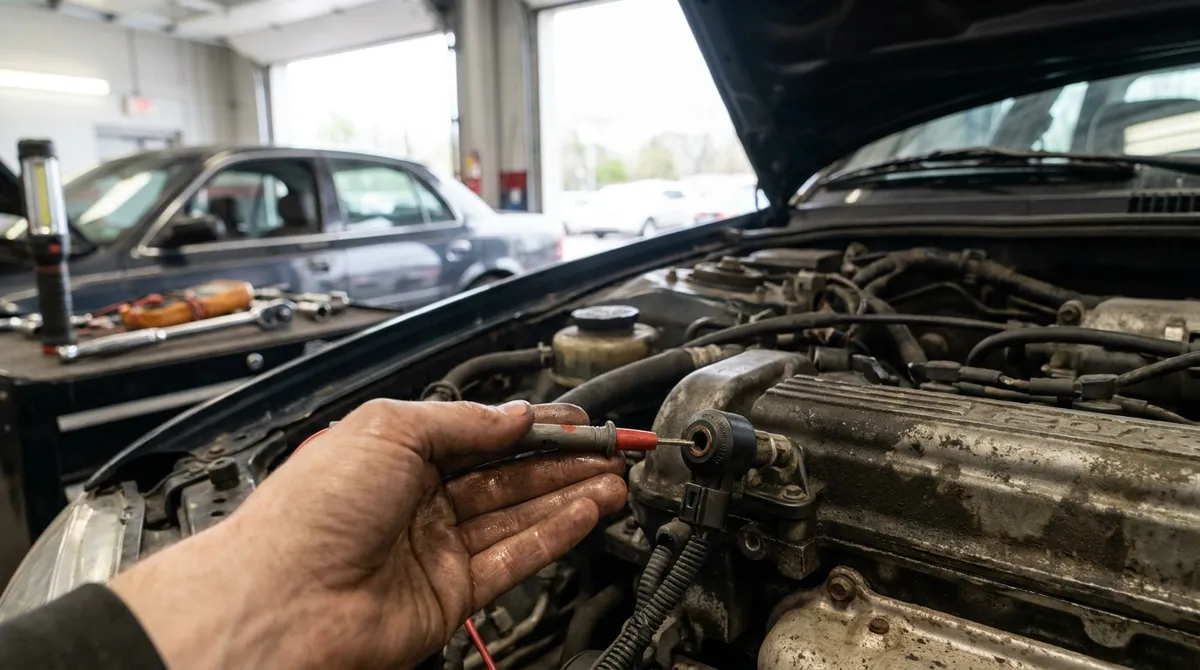
- Test the Sensor: If you’re comfortable with a multimeter, you can often test the knock sensor’s resistance or voltage output according to your vehicle’s service manual. This can tell you if the sensor itself is faulty.
- Check Wiring Continuity: Use a multimeter to check for continuity in the wires leading to and from the sensor. This helps pinpoint any breaks or shorts in the circuit.
For many folks, getting to the knock sensor can be a real pain, especially if it’s buried under the intake manifold. If you’re not comfortable digging into your engine’s wiring or replacing sensors in tight spots, it’s always a good idea to take it to a trusted mechanic. They have the specialized tools and diagnostic equipment to pinpoint the exact issue quickly. You can also use tools like the MECH AI app to help understand potential fixes by looking through our fix database for your specific vehicle.
Whatever you do, don’t ignore a P0325 code. Your knock sensor is there to protect your engine, and a faulty circuit means that protection is compromised. Get it diagnosed and fixed to keep your engine running strong and avoid more expensive repairs down the line.