Direct Injection Fuel Injector Replacement: DIY vs. Shop
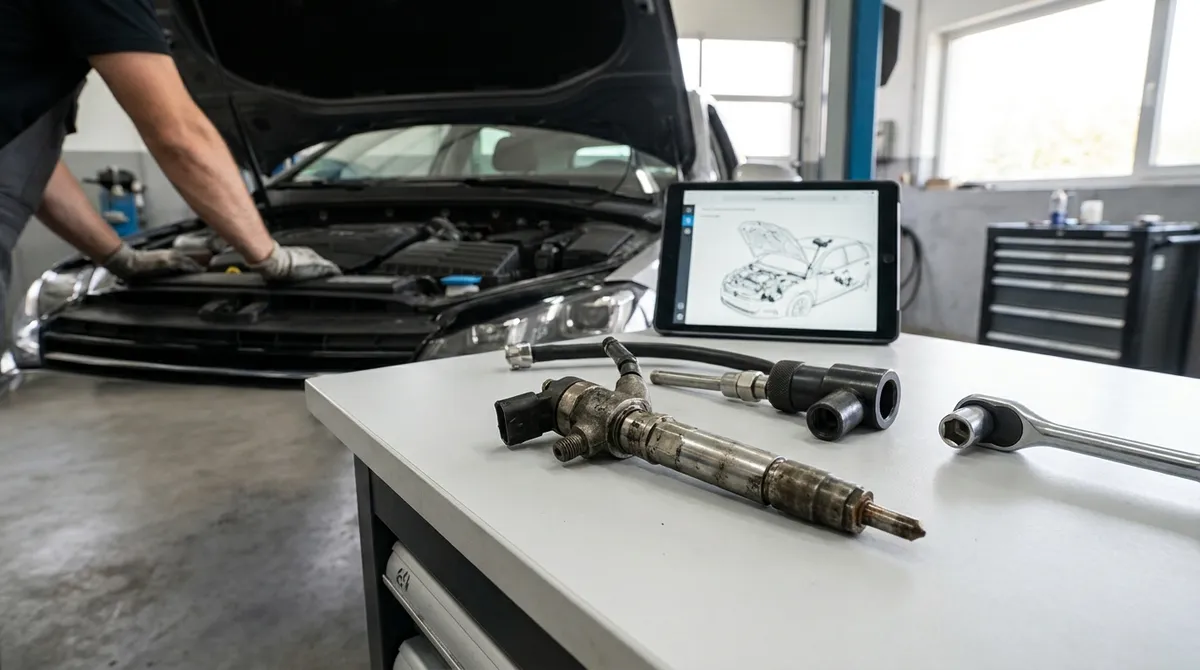
For most owners, gasoline direct-injection injector replacement is a shop job. DIY is worth considering only after diagnosis, with the service procedure for your exact engine, the required tools and experience working on high-pressure fuel systems. Compare the complete repair quote, including seals, pipes and verification, before deciding how much doing it yourself would save.
This guide concerns gasoline direct injection (GDI), not diesel common-rail or port-injection procedures. It helps you evaluate a repair; it is not a removal and installation manual.
Confirm the fault before buying injectors
Rough running, reduced fuel economy or a cylinder-misfire code can prompt an injector investigation. They do not establish that an injector has failed. Record the codes and symptoms, and ask what testing distinguishes an injector problem from ignition, compression, wiring or fuel-supply faults.
Manufacturer bulletins can change the diagnostic path, but only for their specified vehicles. For example, Hyundai bulletin 26-FL-001H directs injector replacement when both its vehicle applicability and listed misfire-code criteria are met. It explicitly directs normal diagnosis outside those conditions. Do not apply its replacement rule to every car with P0301.
If you smell raw fuel or see a leak, stop safely, switch off the engine and arrange professional assistance. Do not restart a leaking vehicle to demonstrate the fault. A flashing check-engine light with severe shaking also calls for stopping safely and assessing whether the vehicle needs recovery, rather than continuing the trip.
What makes the repair demanding?
GDI injectors deliver fuel into the combustion chamber. Their installation involves more than replacing an electrical connector and a bolt. Bosch’s service guidance calls for appropriate removal and seal tools, protection of the injector tip, strict cleanliness and replacement of specified service-kit parts when an injector is removed and reused.
Seals have different functions and handling requirements. Bosch distinguishes the combustion-chamber seal from the fuel-rail seal; a lubrication instruction for one must not be applied to the other. Follow the exact injector and engine instructions, including any seal sizing, replacement fasteners and torque requirements.
Residual pressure must be released using the manufacturer’s procedure before opening the fuel system. Switching the engine off is not a substitute for that procedure. Hyundai’s bulletin refers technicians to its shop manual for pressure release and specifies a new high-pressure pipe and other replacement parts for that repair. Those parts and instructions are examples, not a universal shopping list.
Compare the full cost, not just injector prices
There is no defensible single price for every engine, location and repair scope. Ask for an itemized quote showing:
- The diagnosis and evidence supporting replacement.
- Injector part numbers, quantity, and whether parts are new or remanufactured.
- Required seals, pipes, gaskets and fasteners.
- Labor hours or a fixed labor charge, plus diagnostic charges.
- Any engine-specific coding or adaptation requirement and post-repair checks.
- Taxes, additional fees and written warranty terms.
Illustrative arithmetic only: if a quote lists four injectors at $200 each, $150 of associated parts, four labor hours at $150 per hour and $150 diagnosis, the subtotal is $1,700 before tax and other fees. These assumed figures are not market averages or an estimate for your vehicle. A DIY comparison would still include the $950 in parts, tools, service information and any paid diagnosis or programming.
The FTC recommends a written estimate and checking how labor and diagnosis are charged. It also explains that repair warranties are not standardized. Ask what is covered, for how long, and whether customer-supplied parts change the terms.
Decide whether DIY is realistic
Before taking anything apart, confirm that you can obtain and follow the complete vehicle-specific procedure, identify every required replacement part, and perform the specified final checks. Confirm any coding or adaptation requirement rather than assuming a basic code reader can do it. Clearing codes or resetting fuel trims does not prove the repair is correct.
Choose a shop if the pressure-release procedure, seal tooling, access requirements or verification steps are beyond your experience. Ask whether it regularly services your engine and how it will verify the original fault is resolved. A diagnostic appointment can be the best first purchase when the cause is uncertain.
Bring the shop your vehicle details, symptoms and scan results. Approve a repair supported by diagnosis and a complete quote, rather than ordering a set of injectors from a fault code alone.