What Your Tire Wear Says About Your Suspension
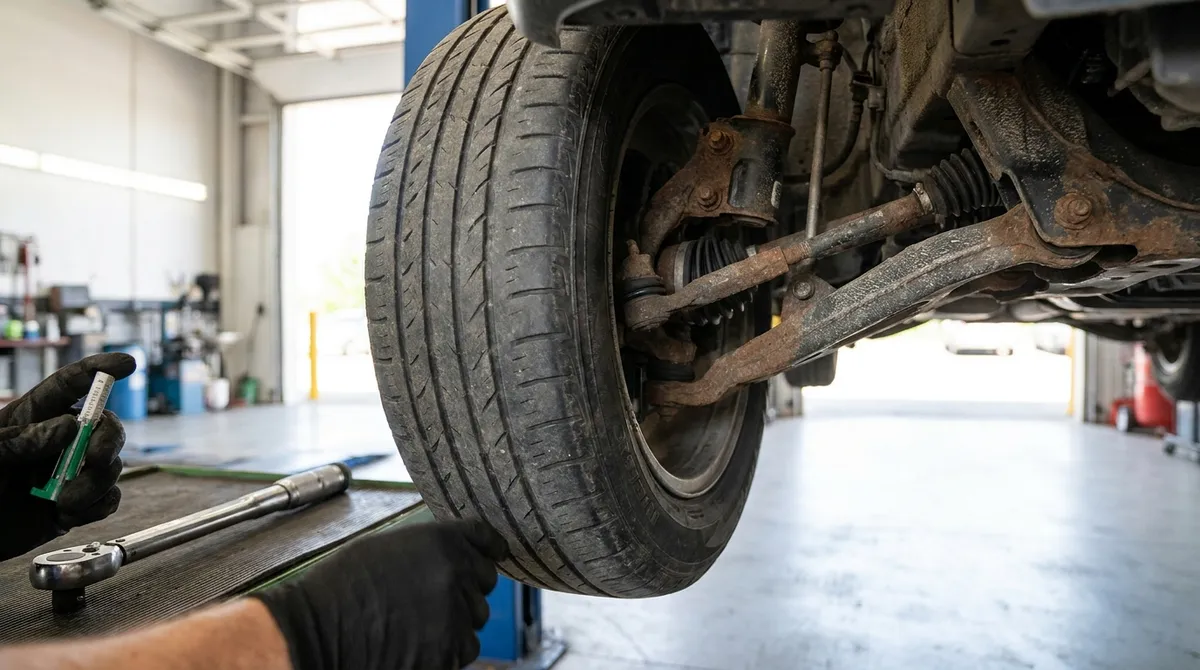
Tires are the only part of your car that actually touches the road, and how they wear can tell you a lot about what’s going on underneath. Most folks just replace tires when the tread is gone, but if you pay attention to how they’re wearing out, you can catch bigger problems with your suspension before they turn into expensive headaches or, worse, safety risks.
Cupping or Scalloping: The Bouncy Ride Indicator
If you look at your tire and see patches of wear that look like scoops or divots around the circumference, that’s called cupping or scalloping. It’s like someone took an ice cream scoop to your tread in spots.
What it means: This pattern usually points to worn-out shocks or struts. When these components are shot, they can’t properly dampen the tire’s movement. Instead of staying firmly planted on the road, the tire bounces as you drive. Each bounce causes a hard impact in one spot, wearing it down faster than the rest.
What to check:
- Visual inspection: Look for fluid leaks on your shocks or struts. If they’re leaking, they’re definitely bad.
- The bounce test: Push down hard on each corner of your car, then let go. The car should bounce up once and settle. If it bounces more than twice, your shocks or struts are likely worn.
- Ride quality: Does the car feel floaty over bumps? Does it nose-dive excessively when braking or lean a lot in turns? These are classic signs of worn dampers. You can read more about what causes that feeling in our post, Why Your Car Feels Floaty: Worn Shocks and Struts.
Next steps: Worn shocks and struts don’t just chew up tires; they affect handling and braking performance. Get them inspected and replaced. After replacement, an alignment is usually a good idea to ensure everything is set correctly.
Wear on One Edge: Camber’s Off
If one side of the tire (either the inside edge or the outside edge) is significantly more worn than the other, you’re likely dealing with a camber issue. This means the wheel isn’t sitting perfectly upright when viewed from the front of the car.
What it means:
- Excessive negative camber: The top of the tire leans inward, causing the inside edge to wear faster.
- Excessive positive camber: The top of the tire leans outward, causing the outside edge to wear faster.
Incorrect camber can be caused by worn ball joints, control arm bushings, bent steering knuckles, or other damaged suspension components. It can also be out of spec if the vehicle has been lowered or lifted without proper adjustment.
What to check:
- Visual inspection: Jack up the car, support it on jack stands (never work under a car held only by a jack), and check for play in ball joints and control arm bushings. Look for cracks or tears in rubber bushings.
- Listen for noises: Worn ball joints can sometimes creak or clunk over bumps.
Next steps: This isn’t something you can usually fix by just replacing the tire. The root cause needs to be diagnosed and repaired. Once the worn or damaged parts are replaced, a four-wheel alignment is essential to get the camber (and other angles) back within factory specifications.
Feathering or Sawtooth Wear: The Toe Angle Problem
Feathering is when the tread blocks on one side of the tire are worn smoothly, and the blocks on the other side are sharp, giving the tread a “sawtooth” feel if you run your hand across it. It feels different depending on which direction you rub.
What it means: This is a classic sign of incorrect toe angle. Toe refers to how much the front of the tires point inward or outward when viewed from above.
- Toe-in: The fronts of the tires point slightly toward each other.
- Toe-out: The fronts of the tires point slightly away from each other.
Either way, the tire is constantly scrubbing sideways against the road instead of rolling straight, and that scrubbing is what shaves the tread blocks into a sawtooth. Worn tie rod ends or other steering components can also contribute to toe issues.
What to check:
- Feel the tread: Run your hand across the tread, both ways. If it feels smooth one way and sharp the other, you’ve got feathering.
- Steering play: With the car off and on the ground, try to rock the steering wheel slightly back and forth. If there’s excessive play before the wheels respond, you might have worn tie rod ends. Sometimes, a general guide to symptoms can help you narrow down what else to look for.
Next steps: Address any worn steering or suspension components first, like tie rod ends. Then, a professional wheel alignment is absolutely necessary to correct the toe angle. Ignoring feathering will rapidly destroy new tires.
Irregular or Choppy Wear: A Mixed Bag
Sometimes, tire wear isn’t neat and tidy. You might see random patches of wear, or the tread might look generally choppy and inconsistent across the tire. This can be a bit trickier to diagnose because it can point to several different issues.
What it means: This kind of wear can be caused by:
- Worn wheel bearings: A badly worn bearing with real looseness lets the wheel wobble instead of spinning true, which can wear the tire unevenly. Bearing makers note this is a less common cause than worn suspension parts, misalignment, or wrong tire pressure, so the bigger clue is the noise: a growling or humming that gets louder with speed and changes when you gently steer one way or the other.
- Bent wheel: A bent rim can cause the tire to make inconsistent contact, leading to irregular wear.
- Seized brake caliper: If a brake caliper is sticking, it can cause one wheel to drag, leading to rapid and uneven wear on that specific tire.
- Tire imbalance: An unbalanced tire can bounce and vibrate, leading to choppy wear patterns.
What to check:
- Wheel bearings: With that corner safely on a jack stand, grab the tire and try to rock it side-to-side and top-to-bottom. Play usually means a worn bearing, though a loose ball joint can mimic it, so have a shop confirm before buying parts.
- Brakes: After a drive, hold your hand near (not on) each wheel. One that radiates far more heat than the others, or a burning smell, points to a dragging caliper. Rotors and calipers get hot enough to burn, so don’t touch them.
- Visual inspection: Look for obvious damage to the wheel rim.
Next steps: This type of wear often requires a thorough inspection of the entire wheel assembly, including the brakes, wheel bearings, and the wheel itself. If you’re not sure where to start, the MECH AI app can help you narrow down possibilities for your specific vehicle and symptoms, acting like your own AI Mechanic.
Don’t just replace your tires and hope for the best. Uneven tire wear is your car’s way of telling you something’s wrong with the suspension. Addressing these issues early not only saves you money on tires in the long run but also keeps your vehicle handling safely and predictably. A quick visual check of your tires every time you fill up can save you a lot of grief down the road.