Car AC Blowing Warm? Here's Where to Start Looking
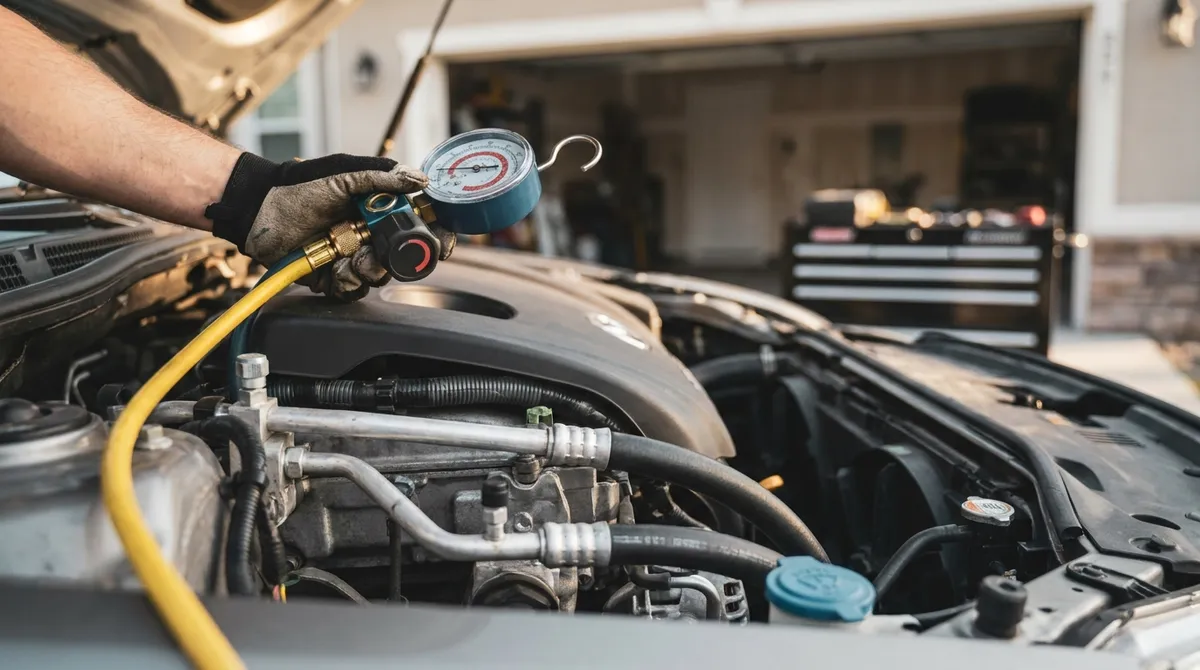
Nothing’s worse than turning on the AC on a hot day and getting a blast of warm air. It’s frustrating, but a warm AC doesn’t always mean a huge repair bill. Often, you can track down the problem with a few simple checks before you even think about taking it in. For more guides on what your car is trying to tell you, check out our full list of symptom guides.
Is the AC Compressor Engaging?
The first thing to check is whether the AC compressor is even trying to do its job. The compressor is the pump that circulates the refrigerant. When you turn on the AC, you should hear a distinct click and see the center part of the compressor pulley (the clutch) start to spin with the outer part.
Here’s how to check:
- Start the engine.
- Turn the AC on full blast and set it to the coldest setting.
- Pop the hood and locate the AC compressor. It’s usually driven by a serpentine belt.
- Watch the center of the compressor pulley. Does it spin? Does it click on and off?
What it means:
- If it’s spinning steadily: The compressor is likely getting power and there’s enough refrigerant pressure for it to engage. The problem is elsewhere.
- If it clicks on and off rapidly: This often means the refrigerant level is too low. The system is trying to protect itself by cycling the compressor off to prevent damage.
- If it doesn’t engage at all: This could point to a few things:
- No refrigerant: The pressure switch detects too little refrigerant and won’t let the compressor engage.
- Electrical issue: A blown fuse, a bad relay, or a problem with the compressor’s clutch coil.
- Bad compressor clutch: The clutch itself might be worn out or faulty.
Check the Refrigerant Level
Low refrigerant (often called Freon, though most modern cars use R-134a or R-1234yf) is one of the most common reasons for warm AC. Refrigerant doesn’t just evaporate; if it’s low, it means there’s a leak somewhere in the system.
You can buy AC recharge kits at most auto parts stores. These kits usually include a can of refrigerant and a gauge. Follow the instructions carefully.
A word of caution:
- Don’t overfill. Too much refrigerant can damage the system just as much as too little.
- A recharge is a temporary fix if there’s a leak. While it might get your AC blowing cold again for a while, the leak will persist. The right way to fix it is to find and repair the leak, then properly evacuate and recharge the system. This often requires specialized equipment and is best left to a professional. If you’re unsure about specific parts or procedures, the MECH AI fix database can be a good resource for common repairs.
Look for Blockages and Electrical Gremlins
Sometimes the problem isn’t the refrigerant or the compressor itself.
1. Condenser Blockage: The AC condenser looks like a small radiator, usually mounted in front of your engine’s main radiator. Its job is to release heat from the refrigerant. If it’s caked with leaves, bugs, or road grime, it can’t do its job, and the AC won’t cool effectively.
- Check: Visually inspect the condenser fins.
- Fix: Gently clean any debris with a soft brush or a low-pressure hose. Be careful not to bend the delicate fins.
2. Cabin Air Filter: This is often overlooked. A clogged cabin air filter restricts airflow into the passenger compartment, making it feel like the AC isn’t working, even if the system itself is fine.
- Check: Consult your owner’s manual for the location (often behind the glove box or under the dash).
- Fix: Replace it if it’s dirty. It’s a quick, cheap fix that many people can do themselves.
3. Fuses and Relays: The AC system relies on electrical power for the compressor, blower motor, and other components. A blown fuse or a faulty relay can shut down parts of the system.
- Check: Locate your fuse box (usually under the hood and/or inside the cabin). Check the fuses labeled “AC,” “compressor,” or “blower motor.” You can also swap AC relays with a known good, identical relay (like one for the horn, if it uses the same type) to test.
4. Blower Motor: If you get warm air, but it’s barely blowing, the problem might be your blower motor or its resistor.
- Check: Turn the fan speed up and down. Does the airflow change? If it only works on one speed, it’s often the resistor. If it doesn’t work at all, it could be the motor or a fuse.
Other Common Culprits and When to Get Help
If the above checks don’t solve it, the problem might be a bit more involved:
- Blend Door Actuator: This part controls whether hot or cold air enters the cabin. If it’s stuck on “hot,” you’ll get warm air no matter what the AC system is doing. This often requires removing parts of the dash to access.
- Pressure Switches: The AC system has high and low-pressure switches that tell the compressor when to engage or disengage. If one of these is faulty, it can prevent the compressor from running.
- Evaporator: This is where the refrigerant actually gets cold inside the car. If it’s frozen up (often due to low airflow or a faulty sensor), it can restrict cooling.
- Compressor Failure: Sometimes the compressor itself just gives up the ghost. This is usually a more expensive repair.
Tracking down a warm AC issue can be straightforward or it can get complicated fast. By checking these common culprits, you’ll either fix the problem or at least have a good idea of what to tell your mechanic. Sometimes, the problem is deeper than a simple check. That’s when getting a professional diagnosis makes sense, and we’ve got a post on when a shop’s diagnostic fee is worth it. And if you want to ask specific questions about your car’s AC, the AI Mechanic can help you figure out next steps.