Check Engine Light After Fill-Up: What to Do
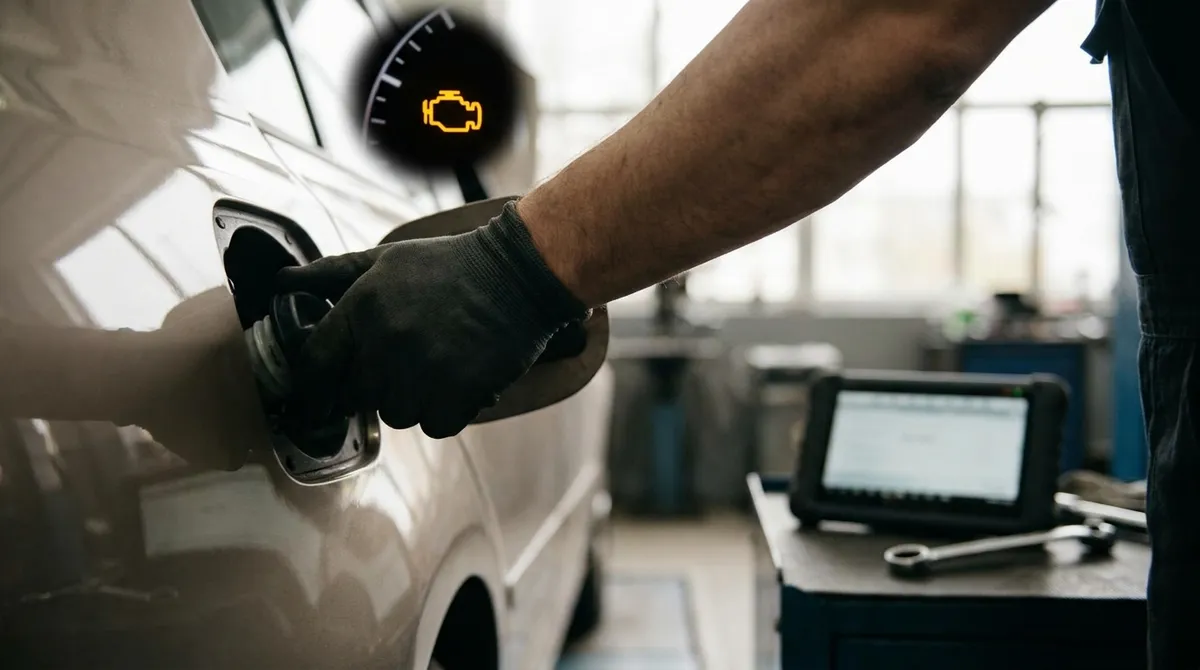
You just topped off the tank, clicked the pump handle back into place, and as you turn the key, bam – the check engine light glows on the dash. It’s a common sight that can make your stomach drop, but often, it’s not as bad as it looks.
The Loose Gas Cap – Your First Check
Most times, when the check engine light (CEL) comes on right after a fill-up, the culprit is simple: the gas cap. Modern vehicles have an Evaporative Emission Control (EVAP) system. Its job is to capture fuel vapors from the tank and send them to the engine to be burned, rather than letting them escape into the air.
Think of it like this: your fuel tank needs to be a sealed system for the EVAP to work right. If the gas cap isn’t tightened down properly – usually until it clicks a few times – that seal is broken. The car’s computer, the ECM, runs tests on the EVAP system. When it finds a leak, even a small one from an open or loose cap, it trips the CEL.
What to do:
- Pull over safely.
- Remove and re-tighten your gas cap. Make sure it clicks at least three times.
- Drive normally. It might take a few drive cycles (starting the car, driving, turning it off) for the light to clear itself. If the cap was the only issue, the light should go off on its own. If it doesn’t, or if it comes back on, then you’ve got something else going on.
Beyond the Cap – Other EVAP System Gremlins
While the gas cap is the easiest fix, other parts of the EVAP system can fail, leading to similar symptoms. These issues might also show up around a fill-up because that’s often when the system is put under new stress or runs its diagnostic tests.
The EVAP system is made up of a few key players:
- Purge Valve (or Purge Solenoid): This valve opens and closes to pull fuel vapors from the charcoal canister into the engine. If it sticks open, it can create a vacuum leak, causing a rough idle or even stalling. If it sticks closed, vapors can build up.
- Vent Valve (or Vent Solenoid): This valve opens to allow fresh air into the EVAP system when the purge valve is pulling vapors, and closes to seal the system for leak tests. If it fails, it can prevent proper system operation or create a leak.
- Charcoal Canister: This stores fuel vapors until the engine can burn them. If it gets saturated with liquid fuel (from overfilling your tank, for example), it can’t do its job right and can even clog.
When these parts fail, the ECM detects an EVAP system leak or an incorrect flow. The codes you might see are often in the P0440 to P0457 range, all pointing to EVAP system problems.
What to do:
- Don’t ignore it. While not always an emergency, EVAP issues can lead to poor fuel economy, rough running, or even damage to other components over time.
- Get the codes read. A simple OBD-II scanner can tell you exactly what code the car is throwing. This narrows down the problem significantly. Many auto parts stores will do this for free.
- Consider professional help. If it’s not the gas cap, diagnosing and replacing EVAP components can get tricky. Some parts are easy to get to, others are buried. A shop has the right tools and smoke machines to find those hidden leaks.
When Things Get Serious – Catalytic Converter Damage
This is less common to happen immediately after a fill-up, but if an EVAP issue (or any other fuel system problem) goes unaddressed for a long time, it can lead to bigger headaches. A constant EVAP leak or a stuck-open purge valve can cause the engine to run too rich, meaning too much fuel and not enough air.
Running rich sends unburned fuel into the exhaust system, which can overheat and damage your catalytic converter. A bad catalytic converter is an expensive repair, often thousands of dollars.
Signs of a failing catalytic converter:
- Reduced engine performance.
- Decreased fuel economy.
- A sulfur or “rotten egg” smell from the exhaust.
- The check engine light is on, often with codes like P0420 or P0430.
What to do:
- Address the root cause quickly. If you suspect a rich condition or have persistent EVAP codes, get it fixed. Preventing cat damage is much cheaper than replacing it.
- Don’t drive with a flashing CEL. A flashing check engine light means there’s a serious misfire or other engine problem that’s actively damaging the catalytic converter. Pull over safely as soon as possible and get it towed.
When to Ignore (and When Not To)
Let’s be clear: “ignoring” a check engine light is rarely the best long-term strategy. However, there are times when you can give it a little grace period.
- You can probably wait a bit if:
- The light came on right after a fill-up, and you suspect the gas cap.
- The light is solid (not flashing).
- The car is driving completely normally – no strange noises, smells, or performance issues.
- You’ve tightened the cap and are waiting for the light to clear.
- NEVER ignore if:
- The check engine light is flashing. This indicates a severe engine problem that needs immediate attention to prevent major damage.
- The car is running poorly (rough idle, stalling, loss of power, strange noises).
- There’s a strong smell of fuel or exhaust.
- The light comes back on after you’ve already tightened the cap and driven for a while.
The MECH AI app can help you understand what those codes mean and suggest